
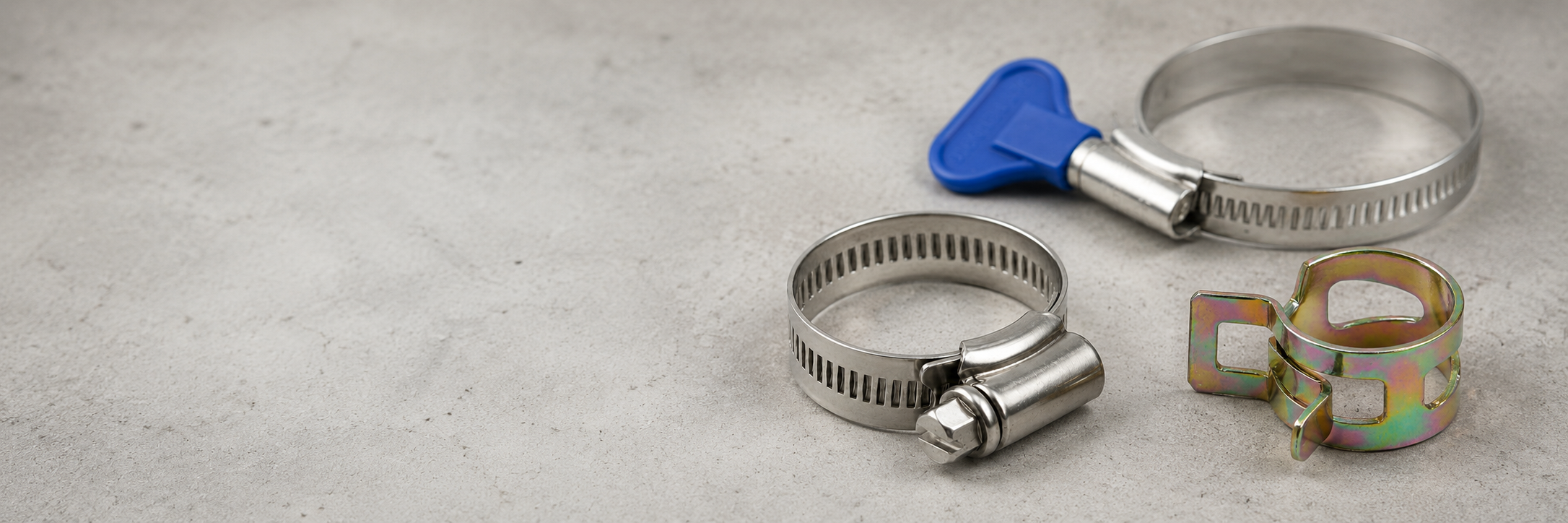
How to Choose the Right Hose Clip
Choosing the right hose clip is not just about finding one that tightens up. The clip needs to suit the hose size, hose material, fitting type and the job it is doing.
A clip that is too small may not fit once the hose is pushed onto the pipe or hose tail. A clip that is too large may tighten unevenly or run out of adjustment before it grips properly. The wrong style can also damage soft hose, fail under vibration or make future removal harder than it needs to be.
This guide explains how to measure for a hose clip and when to use the most common types, including standard hose clips, Jubilee branded hose clips, mini hose clips, wide band hose clips and hose clip tools.
How to Measure for a Hose Clip
The most important step is measuring the hose at the point where the clip will actually sit. That usually means measuring the outside diameter of the hose after it has been pushed over the pipe, spigot or hose tail.
Do not measure the loose hose on its own and assume that is the finished size. Once the hose is fitted over a connection, the outside diameter will normally be larger.
Quick rule: fit the hose first, then measure the outside diameter where the clip will sit. Choose a clip size where your measurement sits comfortably inside the clip range, not right at the very top or bottom.
How Hose Clip Sizes Work
Most hose clips are sold with a size range, such as 35-50mm. This means the clip can tighten down to around 35mm and open up to around 50mm.
For best results, avoid choosing a clip where your hose measurement is right at the limit. If the hose measures 50mm, a 35-50mm clip may be too close to the maximum range. A slightly larger range may give better adjustment and a neater fit.
Before Ordering, Check:
- The outside diameter of the hose once fitted
- The size range of the hose clip
- Whether the hose is soft, reinforced or heavy duty
- Whether the hose is used for fuel, water, air or general fluid transfer
- Whether the clip needs to be removable or permanent
- Whether access is tight and a hose clip tool may be needed
Main Types of Hose Clip
Different hose clips do the same basic job, but they are not all suited to the same applications. This table gives a simple guide to the most common types.
| Type | Best For | Things to Check |
|---|---|---|
| Standard hose clips | General hose securing on water, air and light fluid applications. | Check the size range and make sure the band width suits the hose. |
| Jubilee branded hose clips | Jobs where a recognised branded clip is preferred. | Useful where quality, consistency and brand preference matter. |
| Mini hose clips | Small bore hose, fuel hose, washer hose and compact pipework. | Do not use an oversized standard clip on a very small hose. |
| Wide band hose clips | Larger hoses, softer hose walls and jobs needing a broader clamping area. | Check the width will fit the available space around the hose tail. |
| Ear clips and O clips | More permanent hose connections where a neat, secure crimp is needed. | Usually need the correct crimping tool and are not removed like screw clips. |
| Fuel pipe clips | Fuel lines and small flexible pipework. | Make sure the clip gives even pressure and does not cut into the hose. |
| Snapper clips | Quick fitting applications where a reusable plastic style clip is suitable. | Check the hose size and application before using on higher pressure jobs. |
Which Hose Clip Should I Use?
If you are unsure where to start, choose by the job rather than by the clip name.
| Job | Likely Clip Type | Why |
|---|---|---|
| General hose securing | Standard hose clip | Adjustable, removable and suitable for many everyday jobs. |
| Small fuel or washer hose | Mini hose clip or fuel pipe clip | Better fit on small diameter hose. |
| Larger flexible hose | Wide band hose clip | Spreads pressure over a wider area. |
| Permanent small hose connection | Ear clip or O clip | Crimped fit with a neat finish. |
| Workshop stock or mixed repairs | Assorted hose clips or multipacks | Useful when you need several sizes available. |
Do You Need Hose Clip Tools?
Some clips can be tightened with a screwdriver, socket or nut driver. Others need a specific tool, especially ear clips, spring clips or clips fitted in awkward positions.
If access is tight, a proper hose clip tool can save time and reduce damage to the clip, hose or surrounding parts.
Common Hose Clip Mistakes
Most hose clip problems come from measuring incorrectly or choosing the wrong style for the job.
Common Mistakes to Avoid:
- Measuring the bare hose before it is fitted
- Choosing a clip at the very edge of its size range
- Using a large standard clip on very small hose
- Using too narrow a clip on soft or heavy hose
- Over-tightening and damaging the hose
- Under-tightening and leaving the connection loose
- Using a removable screw clip where a crimped clip is needed
- Using the wrong tool and damaging the clip head
Hose Clip Q&A
How do I know what size hose clip I need?
Fit the hose onto the pipe, fitting or hose tail first, then measure the outside diameter of the hose where the clip will sit. Choose a hose clip size range that comfortably covers that measurement.
Should I measure the inside or outside of the hose?
For hose clips, measure the outside diameter of the hose once it is fitted. The clip goes around the outside, so that is the measurement that matters.
Are Jubilee clips and hose clips the same thing?
Jubilee is a well-known hose clip brand. People often use “Jubilee clip” to describe screw type hose clips in general, but branded Jubilee clips are a specific product range.
When should I use a wide band hose clip?
Use a wide band hose clip when you need a broader clamping area, especially on larger hose or softer hose that could be damaged by a narrow band.
Are mini hose clips better for fuel hose?
Mini hose clips are often better for small diameter hose, including many fuel hose applications. The key is choosing the correct size and making sure the clip tightens evenly without cutting into the hose.
Can I reuse a hose clip?
Screw type hose clips can often be reused if they are not damaged, corroded or rounded off. Crimped ear clips and O clips are usually treated as single-use and replaced when removed.
Find the Right Hose Clip
Browse our full range of hose clips, clamps, tools and assorted packs to find the right size and type for the job.
Browse Hose Clips & Clamps Browse Assorted Hose Clips Open a Trade Account
