


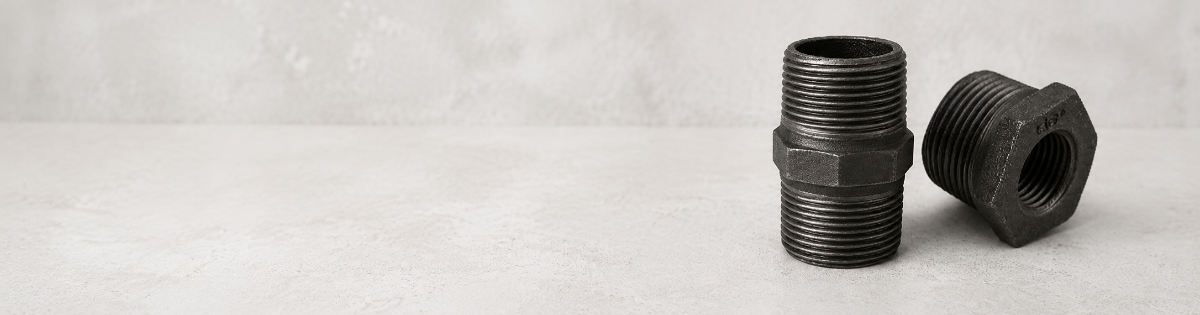
When Should You Use Malleable Iron Hose Fittings?
Malleable iron fittings are commonly used where a strong, durable threaded connection is needed for pipework, hose systems, pumps and general workshop repairs.
They are not the right choice for every job, but they are useful when the fitting needs to stand up to regular handling, site use and mechanical strain better than a light-duty plastic fitting.
Quick answer: use malleable iron fittings when you need a tough threaded fitting for general water, air, pipework or pump connection jobs, and the material, thread and sealing method are suitable for the application.
What Are Malleable Iron Hose Fittings?
Malleable iron fittings are metal pipe and hose fittings made for strong threaded connections. They are often used in general pipework, water handling, air lines, pump connections and workshop maintenance jobs.
You will usually see them in BSP threaded fittings such as nipples, elbows, sockets, tees, reducers and pump couplings.
The main appeal is strength. Malleable iron is a practical choice where the fitting may be knocked, tightened, removed, refitted or used in a rougher working environment.
When Should You Use Malleable Iron Fittings?
Malleable iron fittings are useful when the job needs a strong mechanical connection rather than a lightweight fitting.
| Use | Why Malleable Iron Can Work Well | What to Check |
|---|---|---|
| General pipework repairs | Strong threaded fittings for joining, extending or changing pipe runs. | Check BSP size, male/female thread and sealing method. |
| Water handling | Useful for robust water pipe and hose connections. | Check whether the finish and seal are suitable for the water type and environment. |
| Pump connections | Malleable pump couplings can provide a strong connection between pump outlets and hose tails. | Check hose size, BSP thread size and whether a washer is required. |
| Workshop and site use | Handles knocks and regular use better than many light-duty fittings. | Check corrosion resistance and whether galvanised or black finish is better. |
| Air and general service lines | Can be used where a strong threaded fitting is needed. | Check pressure suitability and compatibility before fitting. |
Check the BSP Thread Size
Most malleable iron hose and pipe fittings are selected by thread size. On L&S product pages, this is often shown as BSP, such as 1/2" BSP, 1" BSP or 2" BSP.
One common mistake is measuring the thread and expecting it to match the named BSP size exactly. BSP sizes are nominal pipe sizes, so the measured outside diameter of the thread is normally larger than the name suggests.
Tip: check whether the fitting is male or female, confirm the BSP size and make sure the thread type matches the part you are connecting to.
When Not to Use Malleable Iron
Malleable iron is strong, but it is not automatically the best material for every application.
For some jobs, brass, plastic, aluminium or stainless steel may be a better choice. It depends on the fluid, pressure, environment, weight, corrosion risk and whether the fitting needs to be removed regularly.
Consider Another Material If:
- The fitting needs high corrosion resistance
- The job involves chemicals or aggressive fluids
- A lightweight fitting is preferred
- The fitting needs to be suitable for potable water
- The system requires a specific material standard
- The existing fittings are brass, plastic, aluminium or stainless and must match
Why Do Malleable Iron Fittings Leak?
A leak is not always caused by the fitting itself. It is often caused by the wrong thread, missing seal, poor thread sealing or damage to the connected part.
| Possible Cause | What to Check | Possible Fix |
|---|---|---|
| Wrong thread size | The fitting starts but does not tighten properly. | Confirm the BSP size before replacing. |
| Wrong male/female connection | The part will not connect to the existing fitting. | Check whether you need male, female or male/female. |
| No thread sealant | Threaded joints can leak if not sealed correctly. | Use a suitable thread sealing method for the job. |
| Missing or worn washer | Pump couplings may rely on a washer to seal. | Replace the washer if it is worn, split or missing. |
| Damaged thread | Cross-threading or wear can stop a proper seal. | Replace damaged fittings rather than forcing them. |
| Over-tightening | Too much force can damage threads or seals. | Tighten correctly and avoid forcing mismatched fittings. |
Quick Checklist Before Ordering
Before ordering a replacement malleable iron fitting, check the fitting you are replacing and the part it connects to.
Check These Details:
- Do you need a hose fitting, pipe fitting or pump coupling?
- What BSP thread size do you need?
- Is the fitting male, female or male/female?
- Do you need straight, elbow, tee, socket, nipple or reducer?
- Do you need galvanised or black finish?
- Does the fitting need a washer or thread sealant?
- Is the fitting suitable for the fluid, pressure and environment?
- Is the old fitting leaking because of the fitting, the washer, the hose or the thread?
Common Mistakes to Avoid
Avoid These Mistakes:
- Choosing by appearance only
- Mixing up BSP size and measured thread diameter
- Ordering male instead of female, or female instead of male
- Using the wrong fitting shape for the pipe run
- Forgetting the washer on pump couplings
- Using the wrong sealing method on threaded joints
- Using malleable iron where corrosion resistance or chemical compatibility is more important
- Forcing a fitting that does not thread together smoothly
Find the Right Malleable Iron Fitting
Browse our malleable iron fittings and hose pipe couplings to find the right size, thread and connection type for the job.
Browse Malleable Iron Fittings Browse Hose & Pipe Couplings Open a Trade Account


