


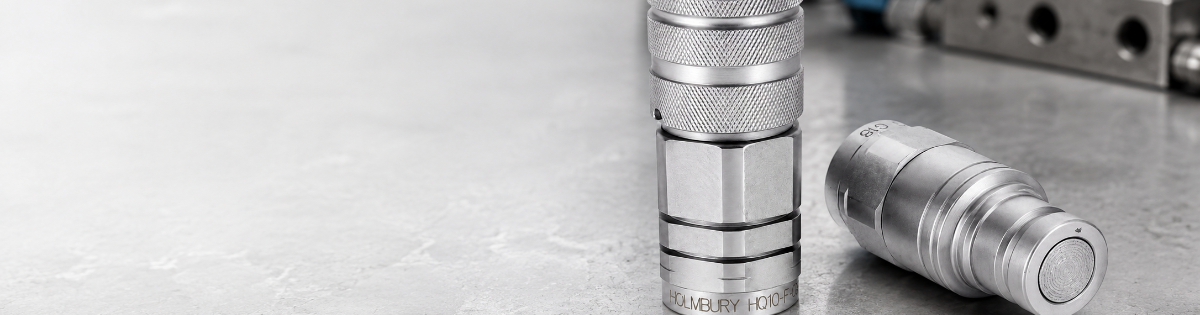
How to Identify the Right Flat Face Hydraulic Coupling
Flat face hydraulic couplings can look very similar, but that does not always mean they are the same. The body size, thread size, thread type, male or female half and sealing method all need to match.
If you are replacing a damaged or leaking coupling, the safest place to start is with the details on the old coupling, the machine, the attachment and the hose fitting. Guessing by appearance alone can lead to the wrong part being ordered.
Quick warning: hydraulic systems can hold pressure even when the machine is switched off. Always follow the machine manufacturer’s safety guidance before removing or replacing hydraulic parts.
What Is a Flat Face Hydraulic Coupling?
A flat face hydraulic coupling is a quick-release coupling used to connect and disconnect hydraulic hoses and equipment. The connection face is flat, which makes it easier to wipe clean before reconnecting.
This helps reduce dirt getting into the hydraulic system and can also help reduce oil loss when the coupling is disconnected.
Flat face couplings are commonly used on plant machinery, attachments and hydraulic equipment where hoses may need to be connected and disconnected regularly.
Is My Hydraulic Coupling Male or Female?
One of the first checks is whether you need the male half, the female half or a complete pair.
| Coupling Half | How to Identify It | What to Check |
|---|---|---|
| Male half | Usually the plug or nose side of the coupling. | Check the body size, thread size and thread type. |
| Female half | Usually the socket side with the locking sleeve. | Check it matches the male half and locks securely. |
| Complete pair | Includes both male and female halves. | Useful when both halves are worn, unknown or leaking. |
If you are replacing only one half, the new coupling still needs to match the other half properly. A coupling that almost fits is not good enough on a hydraulic system.
What Thread Size Is It?
The thread size is the size of the threaded connection where the coupling fits onto the hose, adaptor or hydraulic fitting.
This is not always the same as the coupling body size. For example, two couplings may have a similar body size but different thread sizes. This is one of the most common reasons for ordering the wrong hydraulic coupling.
Body size and thread size are different checks. The body size relates to the coupling connection. The thread size relates to how it attaches to the hose or fitting.
Is It BSP, Metric, JIC or Something Else?
Thread type matters just as much as thread size. A hydraulic coupling may have a BSP, metric, JIC or other thread type depending on the machine, hose or fitting it is used with.
Threads can look similar at a glance, but they may not seal in the same way. Using the wrong thread can cause leaks, damaged threads or a connection that will not tighten correctly.
| Thread Detail | Why It Matters | Common Problem |
|---|---|---|
| Thread size | The coupling must physically fit the hose or adaptor. | A similar size may start to thread but not tighten correctly. |
| Thread type | BSP, metric and JIC threads are not automatically interchangeable. | The wrong thread can damage the coupling or fitting. |
| Seal type | Some seal on a washer, some on a cone, some use an O-ring. | The coupling may tighten but still leak if the seal type is wrong. |
Do I Need the Male Half, Female Half or a Complete Pair?
If only one half is damaged and you are confident the other half is correct and in good condition, you may only need to replace that one half.
However, if both halves are worn, leaking, damaged or unknown, replacing the complete pair is usually the cleaner option. This helps avoid matching a new half to an old coupling that may already be worn.
Replacing One Half May Be Fine If:
- The other half is the correct matching type
- The other half is not worn or damaged
- The locking sleeve still works properly
- The coupling seals correctly
- You know the body size, thread size and thread type
Replace the Complete Pair If:
- Both halves are worn or damaged
- The coupling is leaking and the cause is unclear
- You cannot identify the existing coupling
- The two halves do not connect cleanly
- The locking sleeve is stiff, damaged or loose
- You want to avoid mixing old and new worn parts
Why Is My Hydraulic Coupling Leaking?
A leaking hydraulic coupling is not always caused by the coupling body itself. The leak may be coming from the thread, seal, hose fitting, damaged face or worn matching half.
| Possible Cause | What It Means | What to Check |
|---|---|---|
| Damaged seal | The coupling may not seal correctly under pressure. | Check O-rings, washers and sealing faces. |
| Dirt in the coupling face | Contamination can stop the faces sealing properly. | Clean both halves before reconnecting. |
| Wrong thread type | The coupling may tighten but not seal correctly. | Check if the thread is BSP, metric, JIC or another type. |
| Worn matching half | A new half may still leak when connected to a worn half. | Inspect both male and female halves. |
| Damaged hose or fitting | The leak may not be from the quick-release face. | Check the hose end, adaptor and threaded connection. |
| Trapped pressure | The coupling may be hard to connect or may not seat properly. | Follow the machine guidance for releasing pressure safely. |
Quick Checklist Before Ordering
Before ordering a replacement flat face hydraulic coupling, try to confirm as many details as possible.
Check These Details:
- Do you need the male half, female half or a complete pair?
- What is the coupling body size?
- What is the thread size?
- Is the thread BSP, metric, JIC or another type?
- What seal type does it use?
- What machine or attachment is it fitted to?
- Is the old coupling leaking, worn or damaged?
- Is the other half still in good condition?
- Does the pressure rating suit the application?
Common Mistakes to Avoid
Avoid These Mistakes:
- Ordering by appearance alone
- Mixing up body size and thread size
- Assuming all flat face couplings are interchangeable
- Replacing one half when both halves are worn
- Forcing a coupling that will not connect smoothly
- Ignoring the thread type or seal type
- Reusing a damaged seal
- Not checking for dirt or damage before reconnecting
Find the Right Flat Face Hydraulic Coupling
Browse our hydraulic couplings to find the correct male half, female half or complete coupling pair for the job.
Browse Hydraulic Couplings Open a Trade Account


